
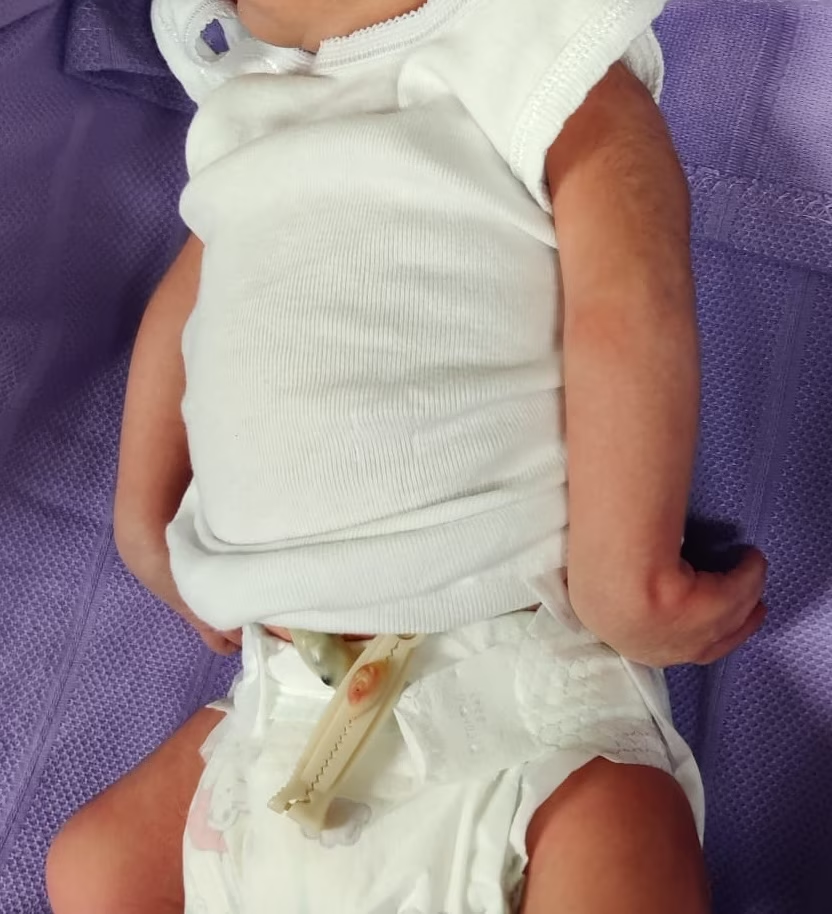
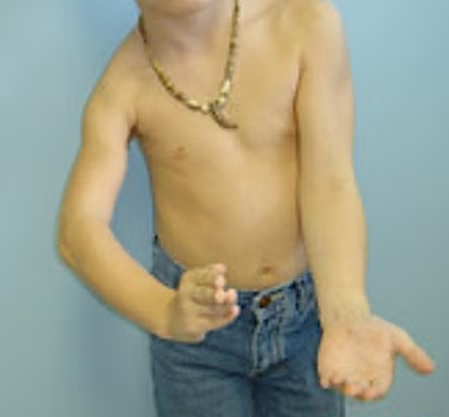
Definition
Birth injury of brachial plexus
Epidemiology
0.5 / 1000 live births
25% develop permanent disability without intervention
Etiology
Traction injury at birth
- high birth weight > 4 kg
- prolonged / difficult labour
- breech
- forceps delivery
- shoulder dystocia
Associations
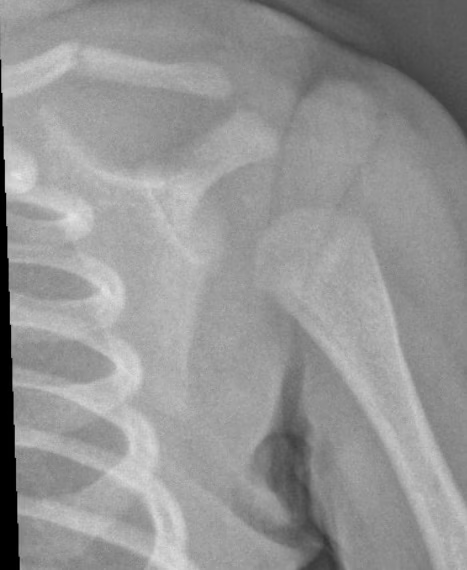
Obstetric clavicle fracture
Most common orthopedic birth injury
Up to 3% of vaginal births
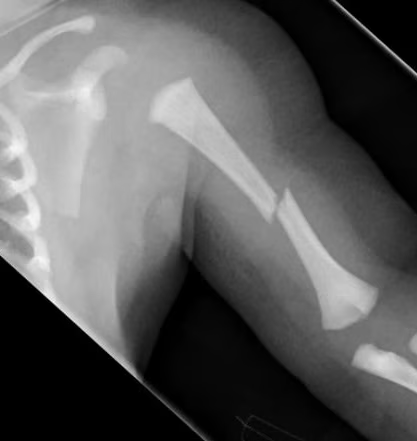
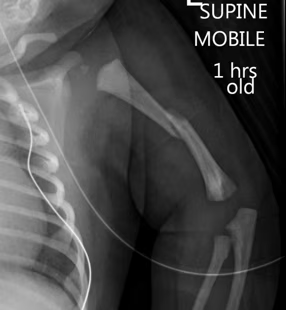
Obstetric humerus fracture
Classification
Narakas Classification
| Group | Nerve roots | Weakness | |
|---|---|---|---|
| Group 1 | C5/6 |
Shoulder abduction Elbow flexion |
Most common |
| Group 2 | C5/6/7 |
Shoulder abduction Elbow flexion Wrist drop |
|
| Group 3 | C5 - T1 | Flaccid arm | Worst prognosis |
| Group 4 | C5 - T1 |
Flaccid arm Horner's syndrome |
Preganglionic injury |
Waiter's tip deformity
| Erb's palsy | Klumpke palsy |
|---|---|
| C5/6 or C5/6/6 | C8/T1 |
|
Waiter's tip deformity - shoulder adducted and internally rotation - elbow extended - forearm pronated - wrist flexed |
Weakness of finger flexion and intrinsics - numb forearm & hand |
Natural history
90% recover overall
Cookie test
- assess biceps function
- see if child will use that hand to bring food to the mouth
Poor prognosis
- no recovery of biceps at 6 months
- total plexus / flail arm / Horner's syndrome
Differential diagnosis
| Pseudoparalysis | Arthrogryposis | Other |
|---|---|---|
|
Clavicle fracture Humeral fracture |
No elbow crease No flexion in utero |
Monoplegic cerebral palsy Cord lesions
|
Nonoperative management
Physiotherapy
Maintain full ROM
Elbow / shoulder
EMG
EMG at 3 months if no recovery
MRI
Valuable if see pseudomeningocoeles
- avulsion of the nerve roots from spinal cord
- poor prognosis
- guides surgical management
Operative management
Indications
No elbow flexion / biceps recovery at 6 months
Timing
9 - 12 months of age
Issues
Preganglionic injury
- more common with total plexus injuries
- avulsion from spinal cord
- no proximal nerve stump for repair
- need nerve transfers
Post ganglionic injury
- more common with C5 / 6 injury
- can repair / nerve graft
Options
Nerve repair - resect neuroma and repair / coaptation
Nerve grafting - resect neroma and sural nerve interposition
Nerve transfer
- preganglionic injury
- accessory nerve to suprascapular
- intercostal nerves to musculocutaneous nerve
- contralateral C7 to lower trunks in total plexus injury
Technique
Supraclavicular approach
- V shaped flap
- divide clavicular head of sternocleidomastoid
- ligate external jugular vein
- divide omohyoid
- ligate supraclavicular artery and vein
- identify plexu between anterior and middle scalene muscles
Results
Outcomes
Muhlestein et al Neurosurgery 2024
- 99 operatively managed obstetric brachial plexus injuries
- 5 year follow up
- recovery of shoulder abduction and forward flexion: 50%
- recovery shoulder external rotation: 65%
- elbow flexion: 75%
Timing
Muhlestein et al Neurosurgery 2024
- better shoulder outcomes with surgery < 9 months v > 9 months
Technique
Tora et al Child Nerv System 2019
- systematic review of nerve graft v nerve transfer
- functional recovery nerve transfer 95%
- functional recovery nerve graft 96%
- systematic review of nerve transfer v nerve graft for suprascapular nerve
- better external rotation with nerve transfer
- higher secondary surgeries with nerve graft
Shoulder management
Issue
Internal rotation contracture
- due to relative weakness of internal rotators (supraspinatus / infraspinatus)
- unopposed action of subscapularis
- over time develop glenoid dysplasia and posterior glenohumeral subluxation / dislocation
Type 1/2: C5/6 lesion
- deltoid usually intact
- internal rotation contracture
Type 3/4: Total plexus injury
- deltoid not working
- flail shoulder
Options
< 3 years
- subscapularis release + anterior capsule release
- open versus arthroscopic
> 3 years
- subscapularis release + anterior capsule release +/- pectoralis major lengthening
- + Latissimus dorsi tendon transfer +/- Teres major to posterior cuff / humerus
Glenohumeral dysplasia
- humeral derotation osteotomy
- +/- opening wedge posterior glenoid osteotomy
Results
- systematic review of tendon transfers for OBPP
- better improvements in abduction with transfer to rotator cuff than humerus
Sabry et al Musculoskeletal disorders 2025
- systemic review of single versus double tendon transfers for OBPP
- no improvement in outcomes with additional transfer of Teres major