
prognosis
Central Cord Syndrome
Epidemiology
Most common pattern cord injury
Hyper-extension injury in middle aged man with osteoarthritic spine
Usually C3/4 and C4/5
Mechanism
Most common type / in older patient with pre-existing spondylosis / OPLL
- hyperextension injury
- compression of the cord
- anteriorly by osteophytes
- posteriorly by infolded ligamentum flavum
Whiplash
Definition
Isolated posterior ligament injuries
- PLL / Posterior interspinous ligament / Paraspinal muscles
Excludes fracture / dislocation / HNP
Aetiology
MVA
Sport
Hyperflexion injuries
Symptoms
Large spectrum clinical presentation
- neck ache
- nausea & vomiting
- headache
- visual symptoms
Spinal Tuberculosis
Epidemiology
Most common site for skeletal TB
- usually haematogenous spread
- can be direct from lung
3 patterns
1. Peridiscal (50%) - originating in metaphyseal region
2. Central - high incidence of vertebral collapse
3. Anterior - instability less common with less bony destruction
Pathology
Affects multiple contiguous vertebrae
Nerve Injury
Epidemiology
Primary THR 1%
Revision THR 3%
DDH 5%
Sciatic nerve 90% of nerve palsy
Other
- femoral nerve
- CPN
- ulna / radial nerve from positioning
Aetiology
Direct
Laceration
- exposure / sciatic and superior gluteal nerve
- drill reamer / obturator nerve
- spike of cement / obturator nerve
Obstetric brachial plexus injury
Definition
Birth injury of brachial plexus
Epidemiology
R > L
1 / 1000 live births
1 in 10 of these develop significant impairment
Recent increase due to bigger babies / DM
Aetiology
Usually secondary to traction
1. Big baby / maternal DM / > 4000 gm
2. Breech
3. Prolonged / difficult labour
Congenital scoliosis
Definition
Lateral curvature of the spine 2° to vertebral anomaly
- causes an imbalance in longitudinal spine growth
Epidemiology
True incidence unknown
F > M
Typically Thoracic
Inheritance
No association in twins / suggests not inherited
5% risk in family if complex multi-level
Aetiology
Background
Definition
Idiopathic condition of the immature femoral capital epiphysis involving varying degrees of osteonecrosis
AKA
- Legg-Calve-Perthes disease
- coxa plana
Described in separate publications in 1912 by
- Legg (Boston)
- Calve (France)
- Perthes (Germany)
Epidemiology
M: F 4:1
1 in 740 males
Synovial Sarcoma
Epidemiology
4th most common STS
- 10-35% of STS
Peak age 3rd-4th decade
- rare in children
Pathology
Cellular characteristics suggest tumour arises from primitive synovial cells
- rarely actually occurs within joint
Characteristic
Occasionally metastasis to lymph nodes (5-7%)
- like Epitheloid Sarcoma
Rhabdomyosarcoma
Definition
Malignant tumour of striated muscle
Juvenile variety arises from mesenchyme
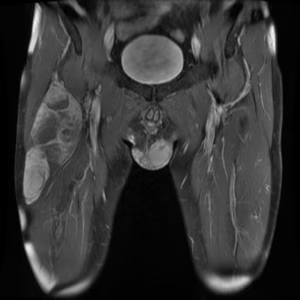
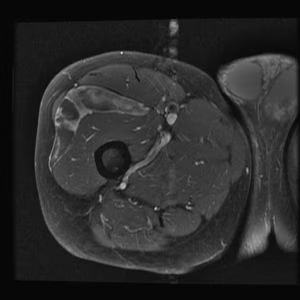
Epidemiology
Most common malignant ST Tumour in children (< 15 years)