
Australian Joint Registry 2025
Reason for revision
19,000 first time revision THA (excluding infection)
- mean 3 - 4 years post primary THA
- fracture 29%
- loosening 28%
- instability / dislocation 26%
- other 17%
Survival revision THA
- Australian Joint Registry 14,000 first time revision THA
- 18 year revision rate 26%
- dislocation / instability most common cause revision 33%
- infection 23%
- loosening 23%
- fracture 10%
Osteolysis
Periprosthetic osteolysis
- biological response to particulate matter
- stimulated by wear particles / debris
Types of wear particles
- polyethylene
- PMMA
- Cobalt / titanium
Biological response to wear particles
- small wear particles phagocytosed by macrophages but unable to digest
- stimulate release of cytotoxic factors
- aggregates more macrophages
- release TNF, IL1, IL6, PGE2
- stimulated osteoclastic bone resorption
Component loosening signs
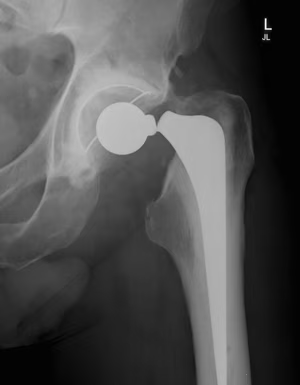
Poly wear
Progressive radiolucent lines (RLL) around implants
Poly wear
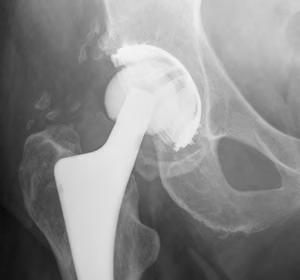
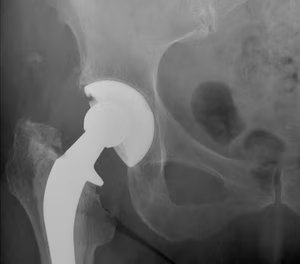
Lucent zones
| Femur Gruen AP zones 1 - 7 | Acetabulum: Charnley Zones |
|---|---|
|
Zone 1: Greater trochanter Zone 4: Tip Zone 7: Lesser trochanter |
Zone 1: Superior 1/3 Zone 2: Middle 1/3 Zone 3: Inferior 1/3 |
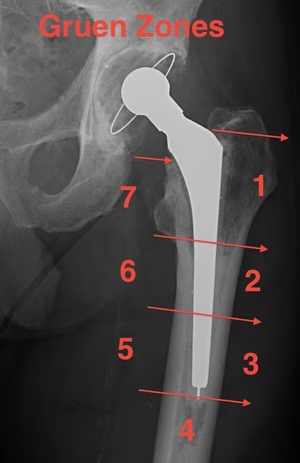 |
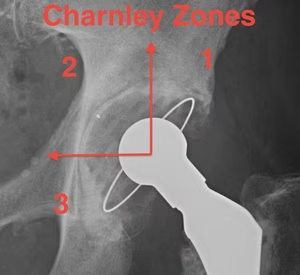 |
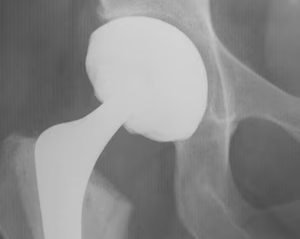
Uncemented femur
Engh classification
Types based on presence of radiolucent lines (RLL)
| Type I: Stable bony ingrowth | Type II: Stable fibrous ingrowth | Type III: Unstable fibrous ingrowth |
|---|---|---|
|
A. Spot welds at end of porous coating B. Absence of RLL next to porous coating C. Calcar atrophy secondary to stress shielding |
A. No spot welds B. Parallel RLL about porous coating C. No migration |
A. Component migration B. Progressive increase RLL C. Pedestal formation (bony hypertrophy at tip) |
Stable bony ingrowth
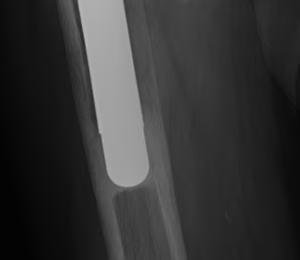
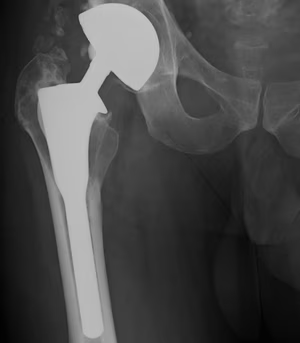
Spot welds Calcar atrophy / stress shielding
Unstable femoral implant
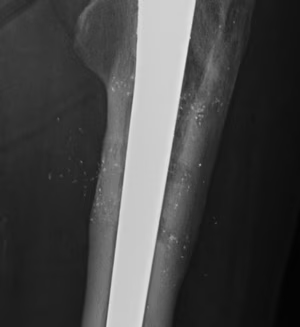
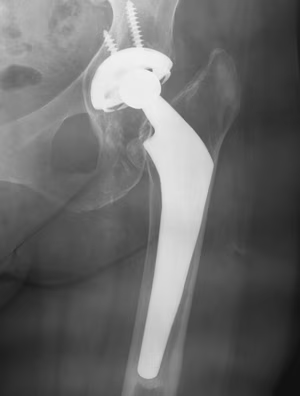
Progressive RLL Pedestal formation
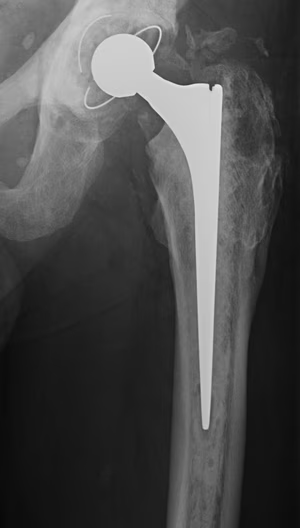
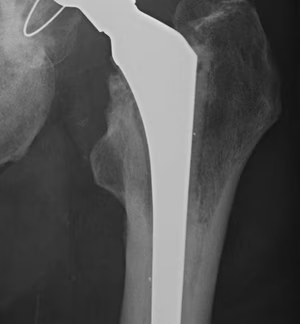
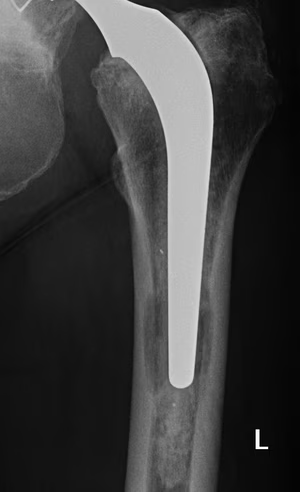
Cemented femur loosening
| Possible | Probable | Definite |
|---|---|---|
|
Bone-cement lucency < 50% May be due to poor cementing |
Cement-implant lucency >2mm wide Progressive |
Implant subsidence Cement fracture Implant fracture Progressive cement-implant lucency Breakdown proximal cement |
 |
 |
 |
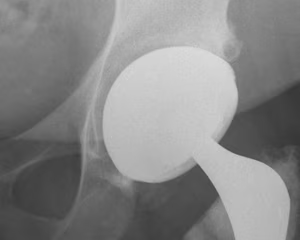
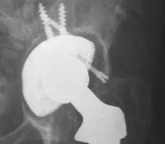
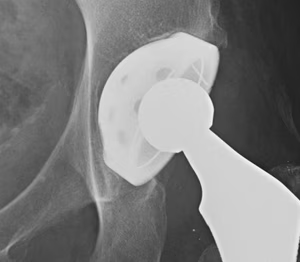
Uncemented acetabular loosening
- 3 or more 97% stable
- 2 or less, 83% unstable
| Bone ingrowth | Loosening |
|---|---|
|
Absence of radiolucent lines Presence of a superolateral buttress Medial bone stress-shielding Radial trabecula Inferomedial buttress |
Radiolucent lines that appear after two years Progression of radiolucent lines after two years Radiolucent lines in all three zones Radiolucent lines 2 mm or wider in any zone Migration > 2mm |
 |
 |
Engh classification
| I Osse-ointegration | II Stable fibrous ingrowth | III Unstable fibrous ingrowth |
|---|---|---|
|
A No RLL B One RLL zone 1 or 2 C RLL zones 1 & 2 |
< 2 mm zone 3 | > 2mm RLL in zone 3 |
 |
 |
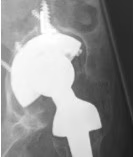 |
Outcomes of revision THA
Component revision
Femoral stem revision only
Hanif et al J Arthroplasty 2020
- systematic review of 700 femoral only revision
- revision rate 7% at 9 years
Acetabular revision only
Poursalehian et al Arch Orthop Trauma Surg 2024
- systematic review of 3500 revision THA
- acetabular revision with retention of well fixed femoral stem
- 10 year femoral stem revision: 2%
- lower femoral stem loosening with ceramic heads
Complications
Dislocation
- systematic review of dislocation after 4600 revision THA
- incidence dislocation 9%
- increased risk: young age, history dislocation, > 2 previous revisions
- reduced risk: elevated rim liners
- Australian Joint Registry 14,000 first time revision THA
- 18 year revision rate 26%
- dislocation / instability most common cause revision 33%
- reduced revision for dislocation with dual mobility / heads > 32 mm
- higher revision for cemented femoral stems first 6 years
- Australian Joint registry 1295 first time revision
- dual-mobility construct versus large femoral heads
- dislocation rate 4% with no difference between groups
Infection
Gold et al Ann Transl Med 2019
- 8500 revision THA from National Database
- overall infection rate 3%
- deep infection rate 1%
- Australian Joint Registry 14,000 first time revision THA
- revision for infection 23% at 18 years
Extended antibiotics
Dasari et al J Arthroplasty 2024
- systematic review of extended antibiotics > 24 hours versus < 24 hours
- no observed benefit for revision of aseptic THA