Management
Deformity
Varus / extension / external rotation
Options
Intertrochanteric
Base of Neck
Subcapital
Osteotomy
Valgus / flexion / internal rotation
Intertrochanteric / Southwick
Technique
- biplanar
- valgising / flexion / internal rotation

Varus / extension / external rotation
Intertrochanteric
Base of Neck
Subcapital
Valgus / flexion / internal rotation
Technique
- biplanar
- valgising / flexion / internal rotation
Displacement of proximal femoral epiphysis in the immature hip
- due to imbalance of mechanical and endocrine factors
Age Peak Incidence : M 12-14; F 11-13; Slight downward trend due to earlier maturation of children
L hip > R
10 / 100 000
No endocrine abnormality
- 20% at time of of diagnosis
- another 20% during diagnosis
- up to 60% with long term follow up
Able to achieve relatively high level of function after STJ fusion
- previously believed that isolated STJ fusion should not be performed
- believed that triple arthrodesis was operation of choice for hindfoot
- STJ fusion has superior result with less stress on AJ
Average loss of DF 30% / PF 10%
Position of hindfoot determines flexibility of transverse tarsal (CCJ & TNJ) joints
- imperative that fusion be positioned in ~ 5o valgus
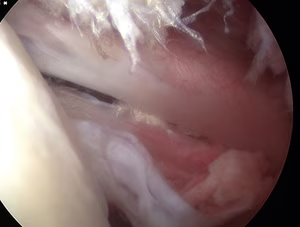
Largest and most powerful rotator cuff
- arises coastal border of scapula
- superior 2/3 tendon inserts into LT
- inferior 1/3 inserts into proximal humerus
Action
- IR (with T major, P major, Lat Dorsi)
- part of force couplet depressing humeral head