
Definition
Multiple definitions based upon age
- Cobb angle < 10° in child < age 5 or 10
- before puberty
- no congenital vertebral malformation
More difficult management due to high growing potential
Can be life threatening due to respiratory compromise due to decreased thoracic height
Epidemiology
1% of idiopathic scoliosis
Natural history
Age < 1 presentation - 90 % spontaneously regress
Age > 1 presentation - 80% progress
Progression Risk
Cobb angle > 30° and RVAD > 20°
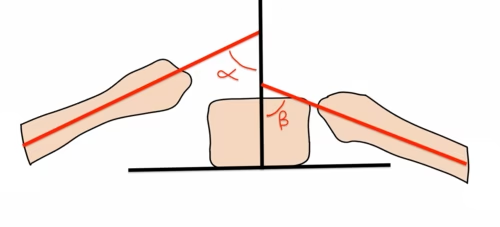
Rib-vertebral angle difference / RVAD
- AP xray
- find apex of curve
- difference in angle at which rib meets spine
CT
Exclude congenital scoliosis
MRI
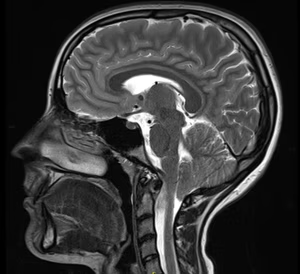
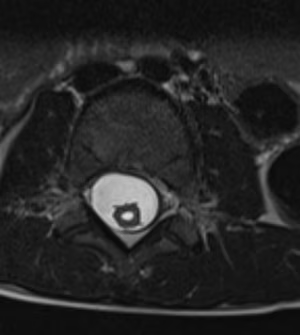
20% incidence intraspinal pathology - syrinx / tethered cord / diastematomyelia / Arnold Chiari Malformation
| Chiari malformation | Syrinx | Cord tethering |
|---|---|---|
 |
 |
 |
Nonoperative management
Indications
Cobb angle > 20o and RVAD > 20o
Serial cast
Technique
Serial elongation derotation flexion (EDF) casting
- high compliance rate
- needs to be changed every 8 - 12 weeks
- child develop risks associated with repeated general anesthesia
Results
Alassaf et al Sage Open Med 2020
- systematic review of casting in infantile idiopathic scoliosis
- mean reduction in Cobb angle 25o
- 54 children mean age 2 years treated with Mehta casting with 5 year follow up
- mean initial Cobb Angle 54o
- 73% improved by at least 20o
- 50% of children had Cobb angle < 15o at most recent follow up
- best results with lower initial Cobb angle and RVAD
Brace
Indication
After casting
- slow curve progression
- prevent surgery
- delay surgery for as long as possible
Results
Bellamy et al Spine Deform 2025
- systematic review of bracing for early onset scoliosis in 870 patients followed to skeletal maturity
- 66% < 5o progression
- incidence of surgery 44%
Operative
Indications
Curves > 60o
Rapidly progressive curves
Options
Posterior growing rods - manual / magnet
Growth modulation - vertebral body tethering
Posterior instrumented fusion
Posterior growing rods
Concept
Maintain growth while correcting scoliosis
Traditional growing rods
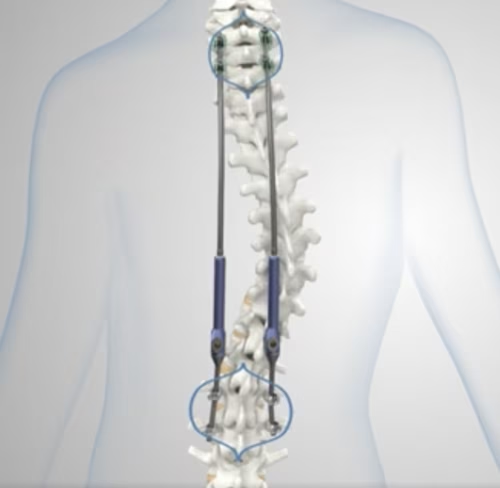
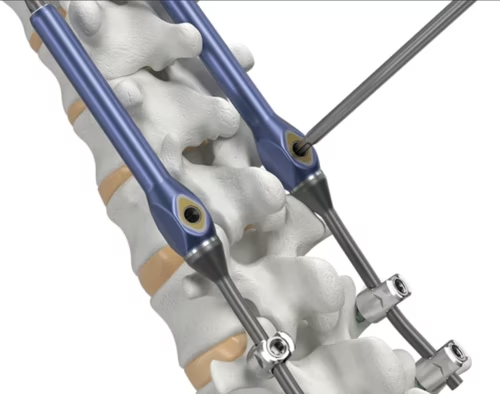
Globus Medical Marvel Growing Rod System
Surgical lengthening every 4 - 6 months
- minimally invasive
- issues with multiple surgeries and anesthesia / wound complications / multiple irradiation
- comparison of traditional growing rods to magnetically controlled growing rods
- 549 patients
- lower complications / reoperations / implant breakage in magnetically controlled
Magnetically controlled growing rods
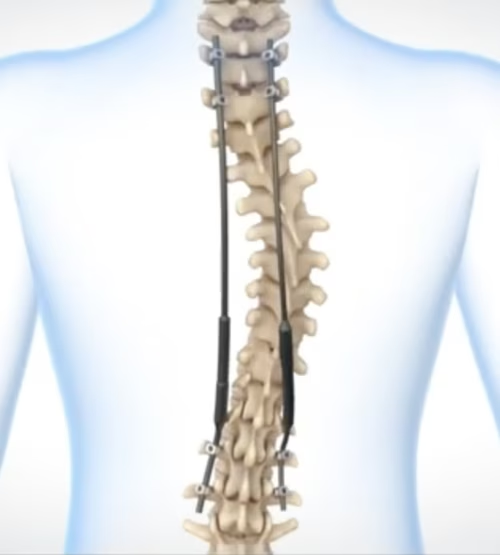
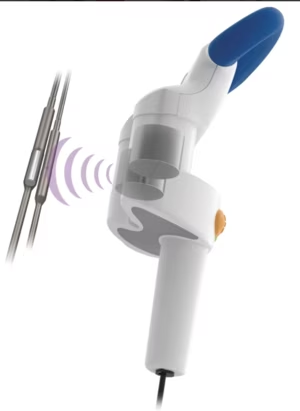
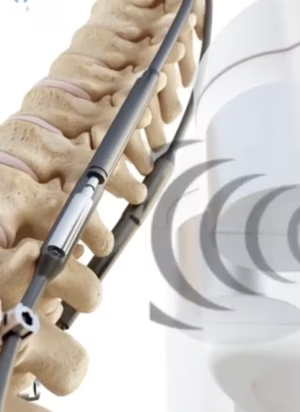
Non invasive distraction but high rate of complications
- systematic review of magnet controlled growing rods
- mean correction Cobb angle 65 to 35o
- mean complication rate 45%
- anchor pull-out 12%, implant failure 12%, rod breakage 11%
- revision rate 33%
- meta-analysis of single versus dual growing rod for early onset scoliosis
- better correction and lower complication with dual rod