
arthrodesis
Management
Non-Operative
Education regarding shoe wear
- extra wide / large toe box
Insoles
- longitudinal arch support
- pre MT dome for metatarsalgia
- podiatry to attend to callosities
Toe spacers
Analgesia
Operative
Indications
1. Continued pain and discomfort
2. Difficulties with shoe wear
Ankle Arthrodesis
Results
90% fusion rates
Lose 70% sagittal plane ROM
Disadvantages of Arthrodesis
Non union rates up to 12%
Decreased gait speed
Poor mobility over uneven surfaces
Subtalar and Triple Arthodesis
Biomechanics
Able to achieve relatively high level of function after STJ fusion
- previously believed that isolated STJ fusion should not be performed
- believed that triple arthrodesis was operation of choice for hindfoot
- STJ fusion has superior result with less stress on AJ
Average loss of DF 30% / PF 10%
Position of hindfoot determines flexibility of transverse tarsal (CCJ & TNJ) joints
- imperative that fusion be positioned in ~ 5o valgus
Rheumatoid Thumb
Nalebuff Classification
Type I - Boutonniere
- commonest
- MP flexion / IP hyperextension
- usually EPB rupture with EPL subluxation
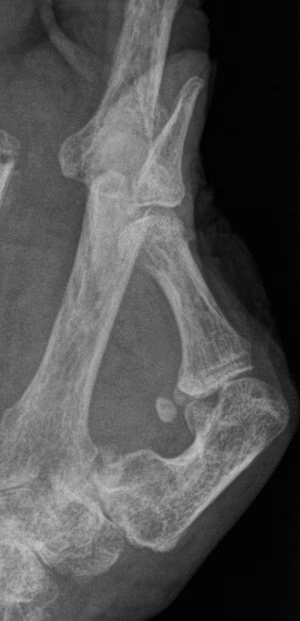
Type II
- Boutonniere & Swan Neck
- doesn't exist according to Nalebuff
Rheumatoid Fingers
Conditions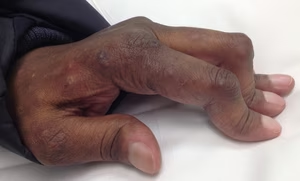
1. PIPJ Synovitis
- synovectomy via dorsomedial approach
2. Flexor tenosynovitis
- may cause trigger finger
- trial HCLA
- remove synovits but don't release A1 pulley
- will worsen ulna drift
3. DIPJ
- rarely affects
Rheumatoid Wrist
Epidemiology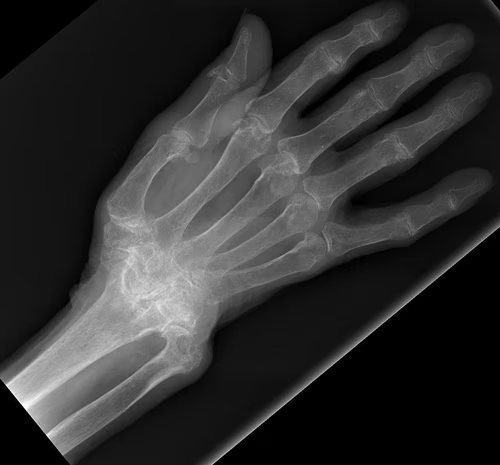
Extremely common
- 90% by 10 years have wrist problems
Principles
Landsmeer 1961
- treat wrist at same time as treat fingers or will recur
Frequently combine procedures
- synovectomy
- tendon transfer
- ulna procedure
Kienbock's disease
Definition
Avascular necrosis & subsequent disintegration of lunate
Aetiology
50-75% history of trauma
Occasionally seen in sickle cell / steroid use
Pathogenesis
Vascular Theory
Trauma disrupting vascularity
- single incident with disruption of blood supply