
Definition
Radial hemimelia - longitudinal failure of formation along radial border / preaxial border
Incidence
1:100 000
4 x Ulna Club Hand
Bilateral 50%
Syndromes
VACTERAL
Vertebral segmentation deficiencies
Anal atresia
Cardiac
Tracheoesophageal fistula
Endocrine including Fanconi's anaemia
Renal abnormalities
Radial ray deficiencies atresia
Limb - CTEV, radial club hand
Holt-Oram syndrome - ASD & RCH
Fanconi syndrome - anaemia & RCH (pancytopenia)
TAR syndrome - thrombocytopenia absent radius
Clinical
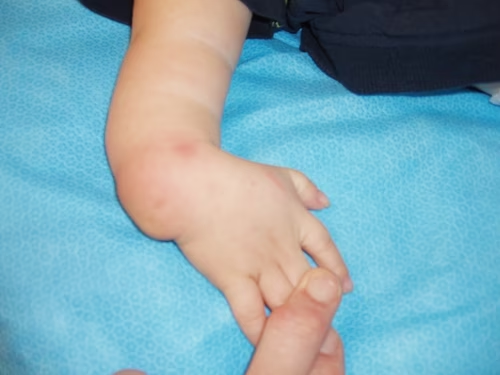
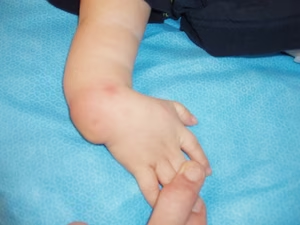
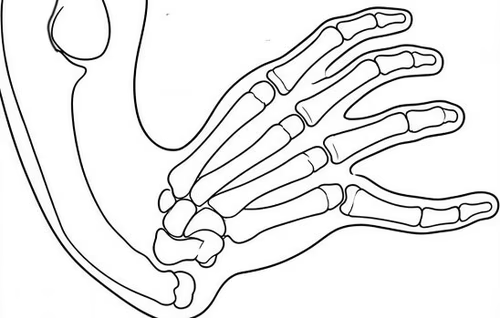
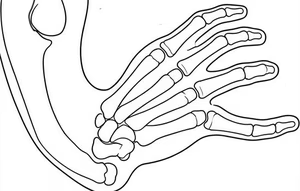
Forearm is short and radially bowed, worsens with growth spurt
Hand deviated in radial & volar direction
- thumb absent in 80%
- radial digits often abnormal
Ulna is bowed & short by 25%
Carpus
- attached to ulna by fibrous tissue or small synovial joint
- scaphoid & trapezium absent in 50% cases
Median nerve
- is thickened as carries sensation for radial nerve as well
- it is located deep to deep fascia on radial border of forearm, at risk from surgery
- at risk from surgery
Radial artery can be absent
Elbow
- 25% have significant elbow extension contracture
- radial deviation may allow hand to mouth
- imperative this function is not disturbed
Bayne classification
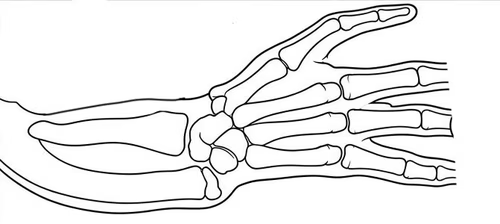
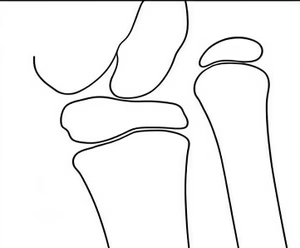
Type I: Short distal radius
Type II: Hypoplastic radius - moderate shortening of the radius & thickening of the ulna
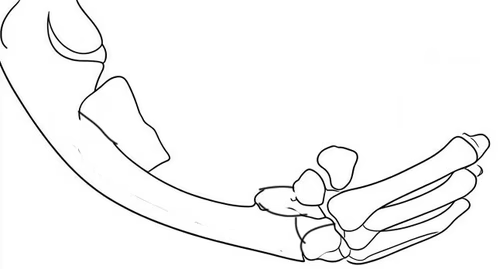
Type III: Partial absence of radius - distal third absent, carpus unsupported & radially deviated
Type IV: Total absence of radius - most common type, carpus unsupported & radially deviated
Management
Nonoperative
Splinting / stretching to limit radial deviation
Operative
Centralization procedure age 1 - 2
- centralising carpus over ulna
- must have elbow mobility - be able to put hand to mouth
- soft tissue release
- tendon transfers ECRL to ECRB
Policization
- thumb absence / hypoplasia
Ulna club hand
Epidemiology
Very rare
4 x less common than radial club hand
Pathology
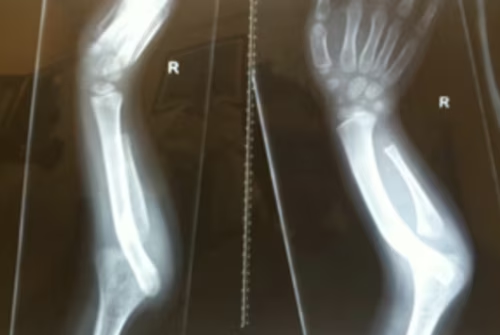
Radiohumeral synostosis common
Radial head dislocation seen in 50% cases
Associations
PFFD
Club foot
Spina bifida
Management
Nonoperative
Stretch / splint to avoid ulna deviation
Operative
Usually unnecessary
Excision of proximal ulna
- create single bone forearm
- lose forearm rotation