
Cause
Movement of iliopsoas tendon over femoral head / iliofemoral ridge / iliofemoral ligament
Can be seen following THA with cup impingement
Total hip arthroplasty
Causes
Anterior component overhang
Oversized acetabular component
Acetabular retroversion
Cement / screws / scar tissue
Clinical
Audible or palpable snap in the groin - rare
Groin pain with hip movement
- stairs
- getting in and out of car
- getting in and out of bed
Examination
- typically pain with active movement rather than passive movement
- pain with straight leg raise
- pain with passive extension and external rotation
Incidence
10% of the population - usually painless
Diagnosis
Dynamic ultrasound
Ultrasound guided local anesthetic and cortisone injection
MRI - iliopsoas bursitis
Total hip arthroplasty


Xray - evaluate acetabular component
CT - evaluate acetabular component
Nonopertive management
Physical therapy
NSAIDS
Ultrasound guided injections into iliopsoas bursa
Operative release
Options
Arthroscopic versus open release
- systematic review of surgical options for internal snapping
- 11 studies and 248 patients
- resolution of snapping seen in 100% arthroscopic and 77% open procedures
- complications seen in 2% arthroscopic and 21% open procedures
Trans-capsular fractional lengthening (arthroscopic) versus release at lesser tuberosity (endoscopic)
Ilizaliturri et al Arthroscopy 2009
- prospective RCT of 19 patients
- no difference in outcomes
Ilizaliturri et al Arthroscopy 2014
- comparative study of 20 patients
- one recurrence in group undergoing trans-capsular fractional lengthening
Arthroscopic trans-capsular technique / fractional lengthening
Technique
Arthroscopic technique article
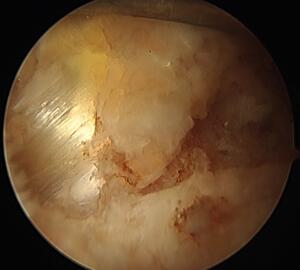
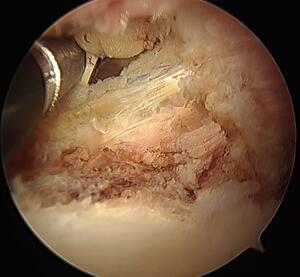
Identify psoas tendon medially
- iliopectineal groove
- at this level the iliopsoas is half tendon and half muscle
- perform fractional lengthening
- release tendon but not muscle
Endoscopic release at lesser tuberosity
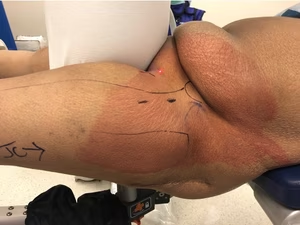
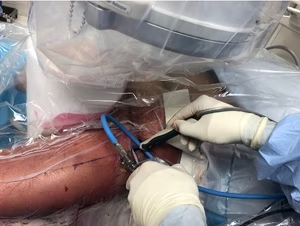
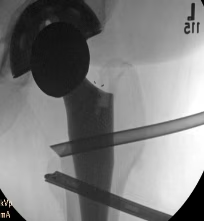
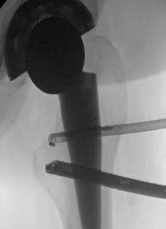
Use image intensifer to triangulate to lesser tuberosity
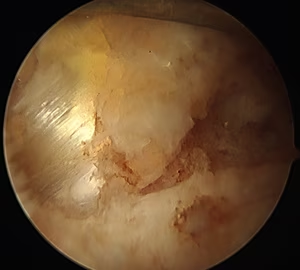
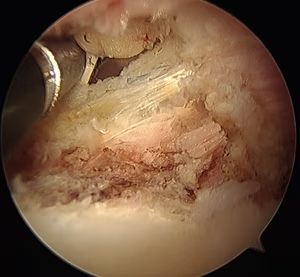
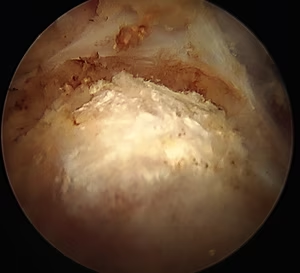
Psoas tendon Diathermy release Cleared lesser tuberosity
Results
Total hip arthroplasty
Shapira et al J Arthroplasty 2019
- systematic review of 280 hips with iliopsoas impingement after THA
- best results with iliopsoas tenotomy compared to revision acetabulum
- lower complications with iliopsoas tenotomy
- reserve acetabular revision for recalcitrant cases
Guicherd et al Orthop Traumatol Surg Res 2017
- 64 endoscopic or arthroscopic iliopsoas release after THA
- 8% ongoing groin pain
- arthroscopy revealed metallosis in two cases, indicating need for revision
Batallier et al Orthop Traumatol Surg Res 2017
- 46 patients undergoing revision acetabulum for iliopsoas impingement
- 83% prominence of anterior cup rim (mean 10 mm)
- 76% cup malposition: anteversion < 10° and/or inclination > 50°
- 9% ongoing groin pain
- 1 deep infection
Efficacy
Gouveia et al Am J Sports Med 2021
- systematic review of outcomes after arthroscopic psoas release
- 21 studies with 875 hips
- majority trans-capsular / level of labrum (93%) versus at lesser tuberosity (7%)
- 93% resolution of internal snapping
- those evaluating strength identified normal strength in 2 studies, and mild decrease in 2 studies
- compared cohort of patients undergoing labral repair and psoas release to those undergoing labral repair only
- >350 in each group
- no difference in outcomes
- having an arthroscopic fractional lengthening of the psoas tendon did not adversely affect outcomes
- compared competitive athletes undergoing FAI surgery to those undergoing FAI surgery + iliopsoase release
- 91% resolution in painful snapping
- no difference in return to sport rates (90%) between two groups
Complications
Weakness
- incidence unclear
- may be decreased with trans-capsular fractional lengthening versus complete release at lesser tuberosity
Continued painful snapping
- may be less common with release at lesser tuberosity
Hip dislocation
- two case reports after psoas release
- important to perform interportal closure in those at high risk
Abdominal compartment syndrome
- associated with hip arthroscopy and trans-capsular psoas release
- allows fluid extravasation into peritoneal compartment
- consider performing after central and peripheral compartment arthroscopy