


Adult hip dysplasia
Definition
Acetabular coverage deficient anteriorly and laterally


Incidence
O'Connor et al Iowa Orthop J 2024
- systematic review 11,000 general adult hip xrays
- prevalence dysplasia 2%
Xray parameters
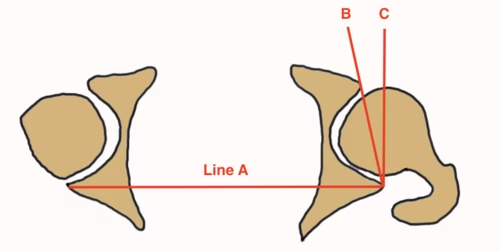
Lateral center edge angle < 20°
Borderline LCEA 20 - 25°
Anterior center-edge angle < 20°


Lateral center-edge angle (LCEA): < 25°


Anterior center-edge angle (ACEA)

Tönnis angle / acetabular inclination: normal between 0° and 10°, >10° dysplasia
CT
Anterior uncovering / reduced acetabular version
Acetabular version


Acetabular version > 25°
MRI
Labral hypertrophy to increase femoral head coverage


Adult dysplasia and Osteoarthritis


Casartelli et al Osteoarthritis Cartilage 2021
- systematic review of 43,000 adult hips
- lateral center edge angle < 25° associated with development of OA
Borderline dysplasia
Definition
LCEA 20 - 25°
Options
Hip arthroscopy
PAO
Results
Quesada et al Arthroscopy 2025
- 74 patients with borderline dysplasia
- treated with hip arthroscopy / capsular plication versus PAO + hip athroscopy
- no difference in outcomes
Alvero et al J Hip Preserv Surg 2024
- systematic review of hip arthroscopy versus PAO for borderline dysplasia
- similar outcomes with each
- increased complication with PAO
Periacetabular osteotomy
Indications
Hip dysplasia / LCEA < 20°
< 40
No osteoarthritis
Ganz / Bernese Periacetabular Osteotomy


Definition
Triplanar supra-acetabular osteotomy leaving posterior column intact
Technique


Patient supine with operative leg free draped
Anterior Smith-Petersen approach
- ASIS osteotomy to release sartorius
- release rectus femoris
Expose ilium
- medially: elevate iliacus subperiosteally
- laterally: elevate gluteus minimus
- homan retractors in greater sciatic notch
Two initial osteotomy cuts under image intensifier
- ischial osteotomy
- superior pubic ramus osteotomy
Two supracetabular osteotomy cuts
- supra-acetabular cut - begin below ASIS osteotomy, stop 1.5 cm short of pelvic brim
- posterior retro-acetabular cut - made with curved osteotome
Rotate anterior and lateral
Screws from ilium to acetabular fragment


Results
Outcomes
- systematic review of 2000 PAO
- 10 year survival 91%
- 15 year survival 85%
- 20 year survival 68%
Complications
Kristiansen et al Acta Orthop 2025
- 1300 PAO mean age 29
- 1% infection rate
Tan et al Orthop Traumatol Surg Res 2022
- systematic review of 3500 Bernese PAO for acetabular dysplasia
- transient lateral femoral cutaneous nerve dysesthesia 8%
- stress fracture 5%
- non-union / pseudoarthrosis ramus 4%
PAO and hip arthroscopy


Indication
Acetabular dysplasia + labral tear
Results
Lukas et al J Hip Preserv Surg 2024
- systematic review of 1000 hips undergoing concomitant PAO and hip arthroscopy
- 63% found to have a labral tear
- no difference in outcome between PAO, and PAO + hip arthroscopy