
repair
Surgical management
Issues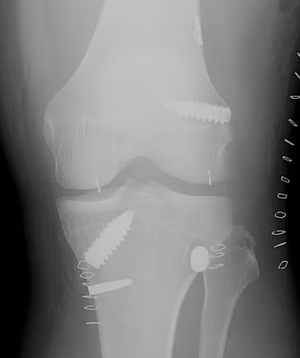
Operative v Nonoperative
Levy et al Arthroscopy 2009
- systematic Review
- improved outcomes with operative management
https://pubmed.ncbi.nlm.nih.gov/19341932/
Vicenti et al. Injury 2019
- systematic review
- two studies compare operative v nonoperative
Pectoralis Major Tears
Epidemiology
Middle age men
Steroids / Growth Hormone
Aetiology
Usually occurs in gym
Bench Press
Clinical
Significant bruising in the acute phase
In chronic setting, ask patient to adduct against hip / resistance
TFCC tears
Definition
Present with pain but not instability
Types
Traumatic
Degenerative
Different treatment algorithms for each
History
Ulna side wrist pain
- may be worse with rotation
- opening doors and jars
History of trauma
Examination
Local tenderness DRUJ
Surgical Reconstruction Issues
Timing of Surgery
Issue
- reported higher incidence with immediate reconstruction in acute phase
- reduced by settling inflammation / effusion and obtaining FROM
- always best to delay if not professional athlete
- problematic if patient has locked bucket handle mensical tear
Results
Bottoni et al Am J Sports Med 2008
- RCT of early (average 9 days) v late reconstruction (average 85 days)
ECU subluxation
Anatomy
6th compartment
- fibro-osseous tunnel overlying 1.5 cm to 2.0 cm of distal ulna
- held tight by the extensor carpi ulnaris tendon sheath
- the extensor retinaculum passes around the ulna to insert on the palmar aspect of the carpus
- extensor retinaculum is a separate structure from the ECU tendon sheath
Mechanism
Forced supination, palmar flexion, and ulnar deviation
Partial thickness tears
Clinical
Pain & Stiffness
- often more pain than FT tears
Bursal side tears more painful than articular
Articular side more common
May see in young patient overhead throwing
Examination
Painful arc
Impingement signs
No weakness
- function good
Subscapularis tears
Anatomy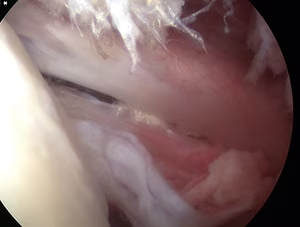
Largest and most powerful rotator cuff
- arises coastal border of scapula
- superior 2/3 tendon inserts into LT
- inferior 1/3 inserts into proximal humerus
Action
- IR (with T major, P major, Lat Dorsi)
- part of force couplet depressing humeral head
Incidence
MCL and Posteromedial Corner
Anatomy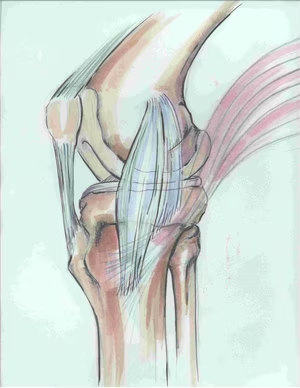
1. Seebacher's 3 layers of the medial knee
Layer 1
- sartorius and sartorius fascia
Layer 2
- superficial MCL
- posterior oblique ligament
- semimembranosus
Layer 3
- deep MCL (meniscofemoral and meniscotibial ligament)
- posteromedial capsule
2. MCL
Superficial MCL