


Types
| Proportionate dysplasia | Dysproportionate dysplasia |
|---|---|
| Symmetrical decrease in limb and trunk |
Short trunk / normal limbs - spondyloepiphyseal dysplasia - Kniest's syndrome - metatropic dysplasia |
|
Mucopolysaccaridoses - Morquio's / Hurler's / Hunter's Severe Osteogenesis imperfecta Severe osteopetrosis Cleidocranial dysplasia Hypophosphatasia / Hypophosphataemia |
Short limb / normal trunk - Achondroplasia / Pseudoachondroplasia - multiple epiphyseal dysplasia - diastrophic dysplasia |
Most common types
| Achondroplasia | Multiple epiphyseal dysplasia | Spondyloepiphyseal dysplasia |
|---|---|---|
| Short limbs / normal trunk | Short limbs / normal trunk |
Very short trunk / short limbs Involves vertebrae and limbs |
| www.boneschool.com/pediatrics/achondroplasia | www.boneschool.com/pediatrics/multiple-epiphyseal-dysplasia |
www.boneschool.com/pediatrics/spondyloepiphyseal-dysplasia
|
Other skeletal dysplasias
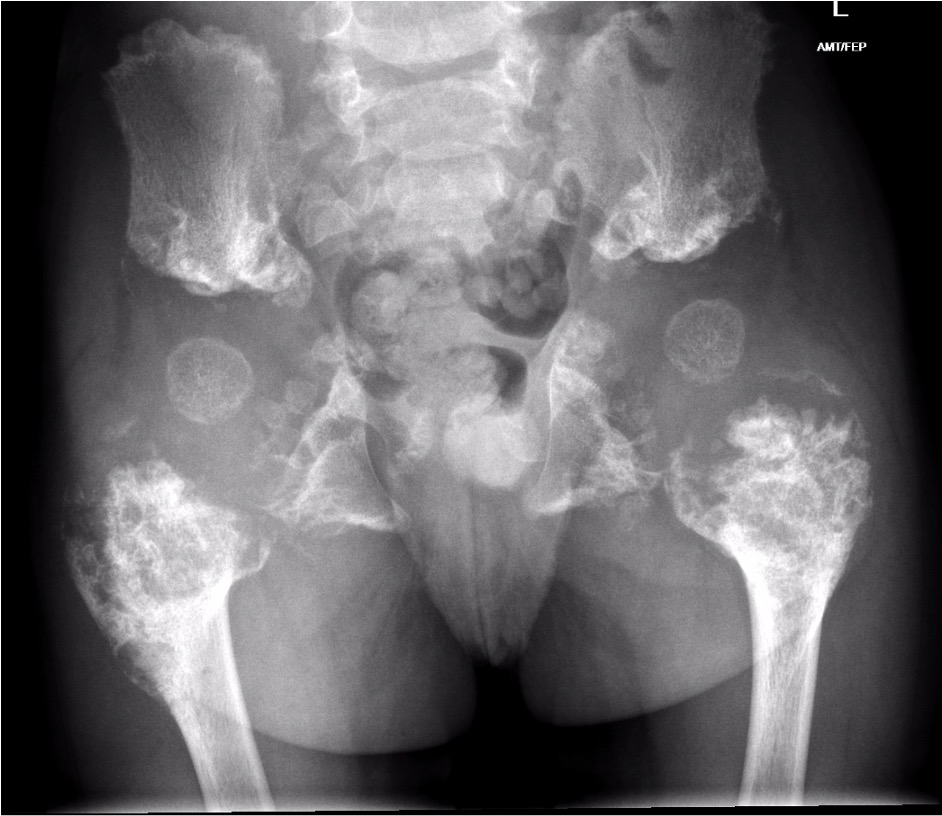
Morquio's syndrome / mucopolysaccaridoses

From: Hendriksk et al Am J Med Genet A 2014
Short trunk dwarfism
- inability to breakdown complex sugars / glycosaminoglycans
- presents between age 1 - 3
- keratan sulphate builds up and disrupts normal bone and cartilage development
- waddling gait, valgus knees, scoliosis, prominent sternum, hip problems
- keratan sulphate in urine
- normal intelligence
Nail patella syndrome


Relatively common
Autosomal Dominant
Features
Hypoplastic / dystrophic nails
Absent or hypoplastic patellae
Posterior iliac horns - pathognomonic
Radial head subluxed laterally/dislocated


From: Kundu et al Indian J Med Res 2018 Jun;147(6):619–620. doi: 10.4103/ijmr.IJMR_1252_16
Metaphyseal chondrodysplasia
Characteristics
Short limbed dwarfism
- normal trunk and spine
- normal epiphysis with metaphyseal changes of tubular bones
- metaphysis adjacent to physis very broad and mildly scalloped
- sclerosing bone deformity
- Erlenmeyer Flask Deformity
- hip coxa vara
- knee valgus
- Jansen type - most severe with developmental delay
- Schmid type - more common, less severe
Diastrophic Dwarfism
Disproportionate dwarfism with very short limbs
- severe cervical kyphosis
- thoracic kyphoscoliosis
- hip dislocations
- severe hip / knee / patella contractures
- clubfoot
Dysplasia epiphysealis hemimelica / Trevor's Disease


Characteristic
Rare, non inherited disease
- osteochondroma that affects one half of the epiphysis
- usually one joint
- ankle joint most common
Management
Excision of mass / overgrowth
- systematic review of Trevor's disease
- systematic review of 70 patients average age 10
- 21% multiple
- most common presentation pain and mass in talus
- 95% treated with surgical excision
- recurrence 9%
Diaphyseal dysplasia / Engelmann's Disease
Cortical thickening of diaphysis of long bones
- bilateral and symmetrical
- starts with femurs and tibias
- metaphysis & epiphysis are normal
- pain and waddling gait
- frequently involves skull and pelvis
- can get blindness and deafness

From: Yuldashev et al Clin Orthop Surg 2017 Feb 13;9(1):109–115. doi: 10.4055/cios.2017.9.1.109