


Issues
1. Increasing prevalence due to increased sports
2. increased early reconstruction due to risk of chondral /meniscal damage from nonoperative care
3. Risk of physeal arrest high with standard ACL reconstruction
Epidemiology
Most occur within 6-12 months of skeletal maturity
Clinical
Hemarthrosis
- 60% of children with a hemarthrosis have ACL tear
- 40% patellofemoral dislocation with osteochondral fracture

Imaging


ACL rupture in 10 year old girl
Growth plate
Distal femoral growth plate: 9 mm/year
Proximal tibial growth plate: 6 mm / year
Greulich-Pyle atlas using PA xray of the left hand
- estimate skeletal age
- peak growth boys skeletal age 14
- peak growth girls skeletal age 12
- 2 years of growth after distal phalanges have fused
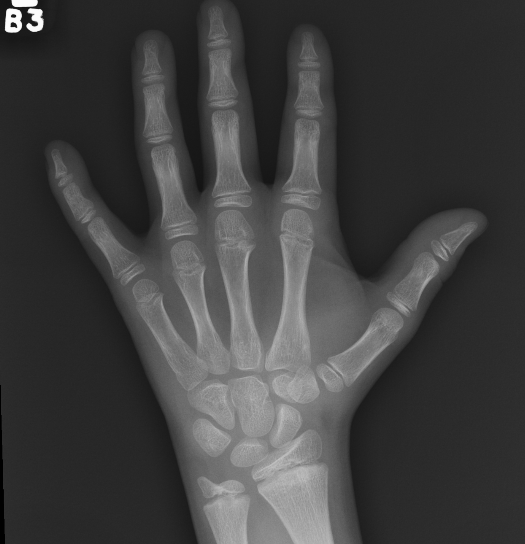
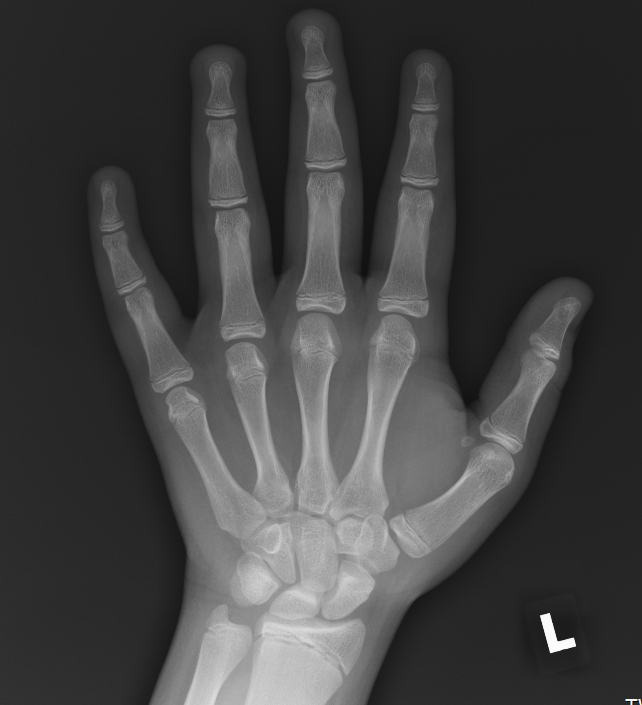
12 year old versus 14 year old hand xray. Distal phalanges have fused in 14 year old.
Nonoperative management
Indication
Delay surgery until close to maturity / reduce risk growth plate injury
Risk ongoing instability and damage to cartilage and mensicus
Results
- systematic review of early versus delayed reconstruction in 2300 skeletally immature
- lower risk of meniscal and cartilage damage with early reconstruction
- systematic review of early versus delayed reconstruction in 1200 skeletally immature
- delaying ACLR > 12 weeks increased risk of meniscal and cartilage damage
Operative management
Indications
Instability
Non compliance
Meniscal tears
Options
Intra-articular +/- lateral extra-articular tenodesis
- physeal sparing / all-epiphyseal
- partial transphyseal
- transphyseal
Extra-articular / over the top
Surgery based upon skeletal age
| Physeal sparing | Transphyseal |
|---|---|
| > 2 years of growth remaining | < 2 years of growth remaining |
|
Boy 13 and under |
Boys 14 and older |
| Girl 12 and under | Girls 13 and older |
Risk of surgery
Growth disturbance - angular deformity / leg length discrepancy
- systematic review of different ACL techniques
- physeal sparing: LLD 3%, angular deformity 2%, graft rupture 8%
- partial transphyseal: LLD 6%, angular deformity 3%, graft rupture 10%
- transphyseal: LLD 1%, angular deformity 2%, graft rupture 6%
- systematic review of ACL reconstruction in skeletally immature
- overall rate of growth disturbance 2.6%
- no difference between trans-physeal and physeal sparing techniques
Graft rupture
Migliorini et al J Orthop Traumatol 2024
- systematic review of all-epiphyseal versus transphyseal in skeletally immature
- 1500 procedures, mean age 13 with mean 4 year follow up
- all-epiphyseal: retear 9%, return to sport 99%
- transphyseal: retear 10%, return to sport 93%
Lateral extra-articular tenodesis (LET)
- systematic review of LET with ACLR in skeletally immature
- 205 patients
- ALCR: graft rupture 13%
- ACLR + LET: graft rupture 1%
Physeal sparing / All-epiphyseal ACL reconstruction
Concept
Tibial and femoral tunnel in epiphysis / don't cross physis


Technique
12 year old male treated with all-epiphyseal using hamstring
Vumedi all-eiphyseal hamstring ACL using endobuttons video
Vumedi all-eiphyseal hamstring ACL using endobutton and screw video


Fluoroscopy required
Tibial tunnel
- tunnel anterior tibial epiphysis
- graft secured with screw post / staple into tibial metaphysis
Femoral tunnel
- femoral tunnel horizontal and remains in femoral epiphysis
- use fluoroscopy guidance to spare the physis
- secured with endobutton / screw


11 year old female treated with all-epiphyseal using hamstring


12 year old boy all-epiphyseal with Arthrex buttons
Results
- 74 patients all-epiphyseal ACLR using hamstring
- 92% good results
- 4% graft failure
Cruz et al J Pediatr Orthop 2017
- 103 patients all-epiphyseal ACLR using hamstring
- average age 12 with 2 year follow up
- retear rate 10%
- 1% minor leg length discrepancy
Transphyseal ACL reconstruction


Principles
Minimize growth plate damage
- tunnels < 7% of growth plate
- tunnel diameter 6 - 8 mm
- vertical tunnels
Prevent physeal bar
- soft tissue / hamstring in tunnel across growth plate
- no screws across growth plate / metaphyseal fixation
- no bone plugs / BPTB across growth plate
Technique


14 year old male with transphyseal ACL with fixation distal and proximal to growth plates
Vumedi transphyseal ACL reconstruction with buttons video
Analogous to adult reconstruction with hamstring autograft
Femoral tunnel
- more vertical
- endobutton not on physis to avoid tethering
Tibial tunnel
- vertical
- ensure screw doesn't cross growth plate
- can use button on tibia
Results
- 94 knees transphyseal 4 strand hamstring ACLR
- mean age 14 with 3 year follow up
- 4% retear
- return to sport 78%
Complications


Valgus deformity after transphyseal ACL reconstruction in a 13 year old male
Partial transphyseal ACL reconstruction
Concept
Transphyseal tibial
Physeal sparing femur / over the top with ITB


Technique
Arthroscopy techniques partial transphyseal using ITB
Extra-articular / Over the Top
Indications
- > 5 years to maturity
- avoid physeal injury
Technique
Vumedi Over the Top ITB ACL reconstruction video
Arthroscopy technique Over the Top ITB ACL reconstruction
Lateral incision
- harvest ITB left attached distally, tubularize
- ITB passed extra-articular around lateral femoral condyle into the knee
- ITB passed under intermeniscular ligament
- passed out anteromedial portal
- fixation distal to the tibial growth plate
Results
- 44 patients average age 10 Tanner 1/2
- 5% revision rate
- no angular or leg length deformity
- 240 knees ITB autograft mean age 11 Tanner 1/2
- 7% graft rupture
- no angular or leg length deformity